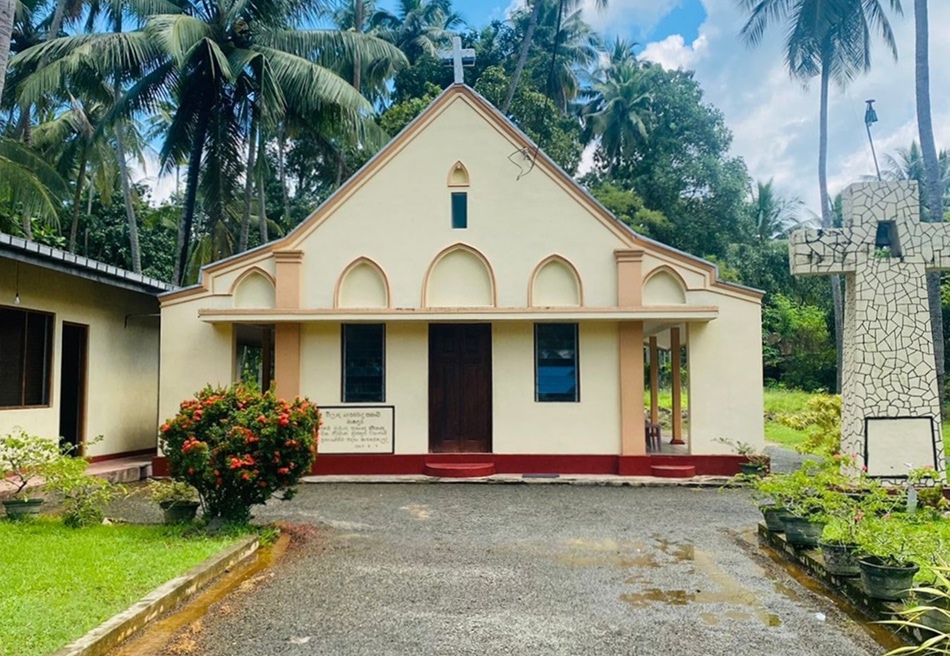
In the quiet heart of Makandura, where paddy fields stretch wide and village paths wind through coconut groves, stands the Makandura Church—a landmark of faith and community. Its story is not one of stone walls alone, but of devotion planted in rural soil by generations longing for a place of worship. The name “Makandura,” from Maha-Kandavura meaning “the big camp,” recalls its past as a gathering ground for armies during british and Dutch times. Yet, in the mid-20th century, it became the setting for another kind of gathering: a community’s longing for God’s Word and a place to worship together.
The roots of the church trace back to the early 1950s, when families in Makandura and the surrounding villages would travel long distances to attend services in larger towns. These journeys were not easy and often taken on foot or bullock cart—but they reflected a devotion that could not be quenched by hardship. Slowly, a vision began to form and the Protestant Christians in Makandura, inspired by the Methodist communion and the wider Reformed witness, began to yearn for a church of their own. Their pleas reached Rev. John Van Ens, who visited the village in 1954 with Dr. and Mrs. D. S. Allan. Their vision was clear: Makandura needed a witness of its own.
That vision was carried forward by committed leaders and the influence of the Dutch Reformed tradition that had spread across Sri Lanka. Evangelist Walter Wijewickrema kept the flame alive with Sunday services and prayer meetings. Ministers made long journeys from Colombo once a month, urging the faithful to “keep on knocking.” They began with prayer meetings and small gatherings in homes, where Scripture was read, hymns were sung, and children learned Bible verses by lantern light. These meetings sowed the seeds of what would become a church family, united not by wealth or status but by a shared hope in Christ.
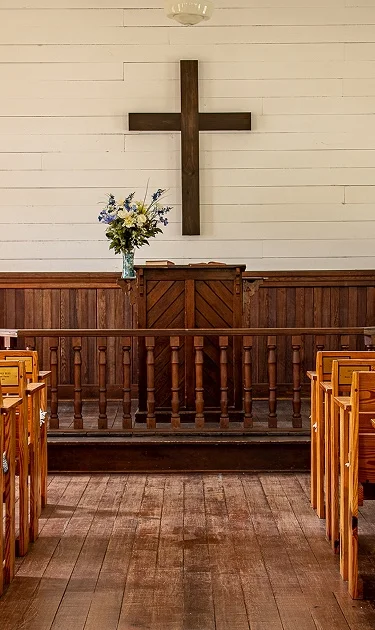
The turning point came in 1955. On Christmas Day, Rev. John O. Schuring conducted the first service on behalf of the Dutch Reformed Church at the Allan residence. Dr. Allan then permitted the construction of a modest church on his estate. Completed in 1957, this humble building—with half walls and a thatched roof—was described by Rev. Van Ens as “a simple yet beautiful church standing among coconut palms”. For many, this was more than building a structure; it was a testimony that God’s presence belonged not only in cities but in villages too.
Evangelist Samuel Mendis was appointed full-time in March that year, guiding the flock with devotion. Sunday mornings filled with worship, children attending Sunday School under the care of devoted teachers, and youth gathering for fellowship gave the church a rhythm that pulsed through the week. Festivals and harvest thanksgivings reflected the deep connection between faith and the farming life of Makandura, reminding worshippers that every grain of rice and every drop of rain came from the Creator’s hand.
On 4th March 1962, the church was raised to the status of a Local Consistory, with its first Elder and Deacon appointed. In 1963, a Mission House was constructed and dedicated, with Evangelist David Kulasena and his family as its first residents. A belfry followed, its bell gifted by Rev. and Mrs. J. W. D. Gauder, and on 27th April 1974, it rang for the first time. By 1977, electricity reached both church and Mission House, symbolizing a new era of progress.
Today, the Christian Reformed Church in Makandura stands as a living testimony to perseverance and faith carrying forward the legacy of its founders ensuring that the Reformed witness stayed strong while adapting to the needs of a changing world. What began as a plea in 1954 grew into a thriving congregation—rooted in prayer, built by sacrifice, and strengthened by God’s grace. Its walls and bell tower tell a story of ordinary villagers who believed that even in a small corner of Sri Lanka, God’s kingdom could take deep root and bear fruit for generations.